Why Response Quality Varies Between Adult AI Chats
Two conversations on the same platform rarely feel equally good, and the reason is usually not the software's mood. Quality tracks four inputs: how much context the thread carries, how the message is written, how fully the character is defined, and how heavy the moment is. A thread with 200 messages of shared history will always read differently from a cold open, whatever else is identical.

Key takeaways
- Context beats eloquence: a thread that carries 200 messages of history gives continuity that no single clever opener can replace.
- Message shape is a variable you control - concrete detail and a clear direction usually outperform one-line prompts.
- Continuity is a stated feature of the category: the characters recall previous interactions and adapt over time.
- When a thread goes flat, diagnose the input rather than the platform, then test one change at a time.
Four inputs decide how an exchange reads
Context is first because it compounds. A character that can draw on earlier messages will match a tone you established last week; a character with a blank thread starts from the character definition and nothing else. That is why the same companion can feel sharp on a long-running thread and generic on a fresh one opened by mistake.
Message shape is second. A vague prompt asks the system to guess at pace, setting and mood, and a guess that misses reads as a weak reply even when the underlying generation was fine. A message that names what you want - a slower exchange, a particular scene, a shift in tone - removes most of the ambiguity before it can become disappointment.
The character definition is third, and it is not under your control. Creators write personalities, appearances and interaction styles, so the ceiling on a conversation is partly set by whoever built the character. The save rates on the trending cards hint at that: one reading converts at 0.0464% of views and another at 0.0155%, a spread that reflects how differently audiences responded to the work on offer.
Why long threads drift and short threads stall
Long threads fail differently from new ones. As a conversation grows, everything said earlier keeps a vote in how the next reply is shaped, so an off-key message from an hour ago can still colour the tone. The usual symptom is a reply that answers a question you asked ten messages back rather than the one you just sent.
Short threads stall for the opposite reason. With nothing to draw on, the character falls back on its most general register, which is competent but rarely memorable. A reader who opens a new thread every session never gives continuity a chance to accumulate, and then blames the platform for the flatness they created by resetting.
Both problems have the same remedy: make the thread's state explicit. Say where the exchange currently stands, correct a drifted tone in one sentence, and keep long-running threads for the characters you actually revisit. Ten seconds of resetting costs less than twenty minutes of sour replies.
What the platform's own wording covers
The client describes the behaviour as realistic advanced responses: natural, adaptive replies, characters that recall previous interactions, express emotions and adapt over time. Read that literally and it explains most variance. Adapting over time is a promise about the direction of travel, not a promise that every single reply lands.
Content modes add another variable. Filtered, Unfiltered and 18+ states change what a conversation can explore, so two threads in different modes should not be compared as if they were the same test. The platform also states that some limitations apply under its content and community guidelines, which is worth remembering before judging a reply that held back.
The practical conclusion is unglamorous but useful: variance is structural, not accidental. It comes from context length, prompt quality, character definition and mode, and three of those four are things you can adjust in under a minute.
| Input | What it changes | Cheap test |
|---|---|---|
| Context in the thread | Continuity, callbacks and tone matching | Ask for a detail mentioned earlier |
| Message shape | Pace, setting and direction of the reply | Rewrite one prompt with a named direction |
| Character definition | The ceiling on personality and voice | Compare two characters on the same prompt |
| Content mode | What the conversation can explore | Confirm which of the Filtered, Unfiltered and 18+ states is active |
| Session length | How much history accumulates between visits | Log minutes per session for a week |
Run the tests in order. Most readers reach for a new character when the real problem was an ambiguous prompt or a stale thread, and a five-minute diagnosis usually saves an hour of shopping.
Worked example: how much of a month a thread uses
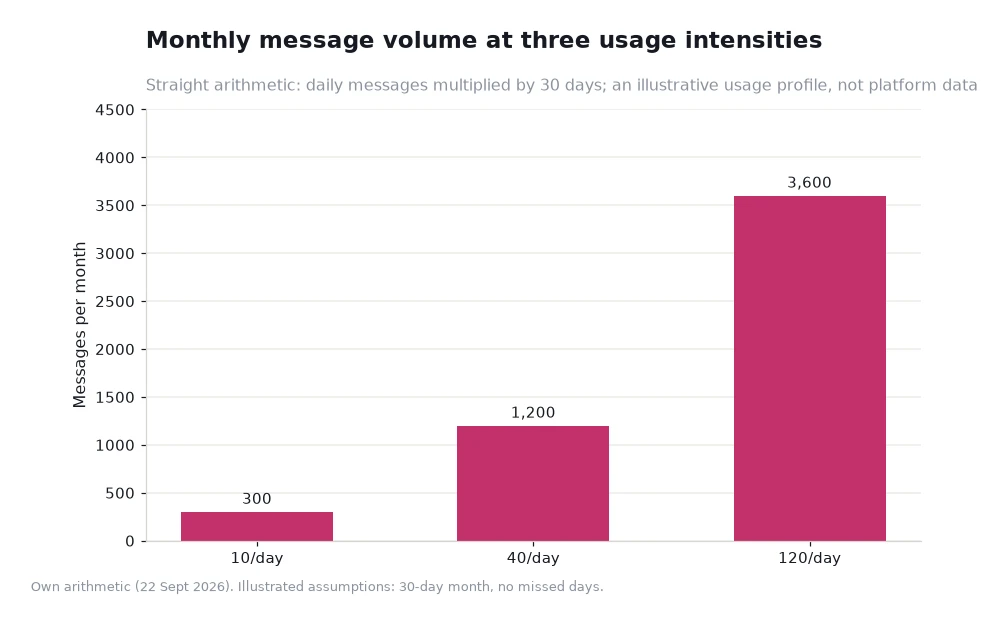
Volume makes the point. Using a 30-day month as an illustrative assumption, 10 messages a day gives 300 messages a month, 40 a day gives 1,200, and 120 a day gives 3,600. Those are three different relationships with the platform, and the arithmetic on them is simple.
Take a 200-message thread in the 3,600-message month: 200 divided by 3,600 is about 5.6%, so a long and carefully built conversation consumes a twentieth of the month's capacity. In the 300-message month the same thread would be two thirds of everything you send, which is why light users feel every weak reply far more sharply than heavy users do.
That single ratio explains a lot of contradictory advice. A reader on 300 messages a month should spend their time choosing characters carefully, because each opening is expensive. A reader on 3,600 can afford three attempts to find the right direction and still have a month of conversation left.
Testing one variable at a time
Quality control is a small experiment, not a search for a better platform. Change one input, compare the next three replies, and keep what worked. The one thing worth knowing before you start is which category you are already using, since the platform's own label for the format is ai sexting with characters it calls Sex AI companions.
Keep a short log for a week: minutes per session, the rough message count, and one word for how the exchange read. Six lines of notes will tell you more about your own variance than a month of hunches, because the pattern is usually a habit rather than a fault. Pair that log with the trending list conversion figures and you can separate a character that does not suit you from a thread you never gave enough context.
Readers who want the feature detail rather than the method can start from the platform's own explanation of how the companions are described, then test against their own log. The evidence that matters is in the thread, not in the copy.
Frequently asked questions
Why is the same character better on some days?
Because the inputs change. A thread with more context, a clearer prompt and a settled mode produces better replies than a cold open, and those three vary more than the underlying system does.
Should I start a new thread when replies feel flat?
Only after correcting the tone once. Long threads can drift, but a fresh thread discards accumulated context, which is usually the most valuable part of a conversation.
Do content modes affect quality?
They affect what the conversation can explore rather than how well it is written, and the platform notes that some limitations apply under its content and community guidelines.
Diagnose before you switch
Keep the next flat conversation and inspect it instead of abandoning it. Check how much context the thread carries, restate what you want in one concrete sentence, and confirm which content mode is active. If three replies later nothing has improved, that is the moment to try a different character, not before.
Sources: the response wording, the Filtered, Unfiltered and 18+ filters and the card counters behind the 0.0464% and 0.0155% figures were read from Crushon on 22 Sept 2026; monthly totals are illustrative arithmetic on a 30-day month and not platform statistics.[1] Material published for an audience of 18 and over.