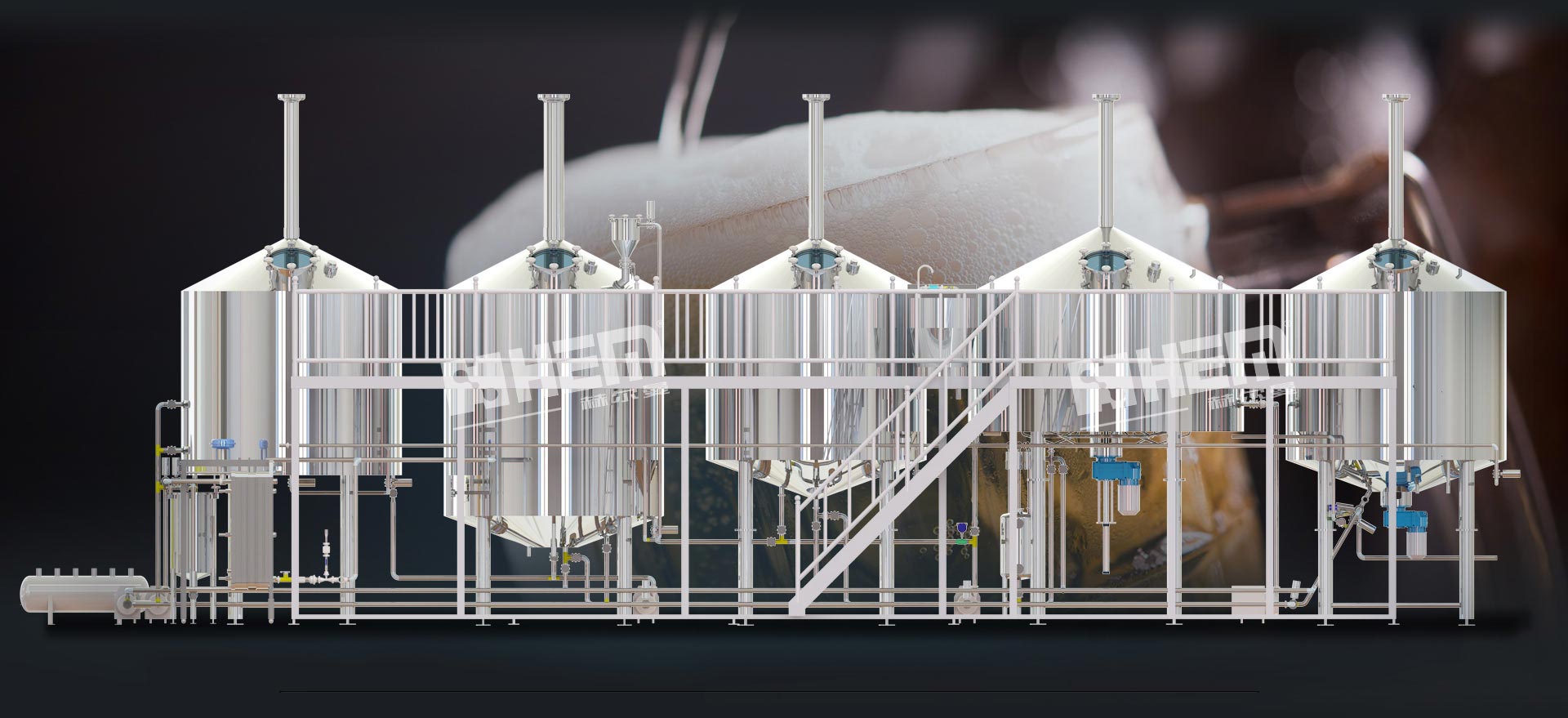
A hem brew system improves recipe control by moving repeatable brewing steps from manual judgment into defined temperature, timing, circulation, and transfer settings. Available configurations include PID panels, semi-automatic PLC touchscreens, and fully automatic PLC control; published equipment ranges cover 1–10 HL small-batch systems and 10–30 HL craft brewhouses. That matters because mash temperature and pH influence enzyme activity, fermentability, and alcohol consistency. ASBC guidance treats both as process-control measurements, while a 1991 brewing study found wort fermentability falling from above 70% to below 30% as mash temperature increased from 65°C to 80°C.
A beer recipe may list 65°C for 60 minutes, 25 kg of malt, a defined liquor volume, and several hop additions, yet those numbers only work when the equipment reproduces them closely. Recipe control is process control: temperature distribution, heating rate, hold time, liquid flow, vessel volume, and transfer timing all influence what reaches the fermenter.
Temperature deserves attention first because mash enzymes respond strongly to relatively small thermal changes. American Homebrewers Association material places a common single-infusion range around 67–68°C, while technical literature shows that alpha- and beta-amylase do not lose activity at the same rate as temperature rises.
The 1991 Journal of the Institute of Brewing study gives the scale of the effect. Raising mash temperature from 65°C to 80°C caused only a limited change in extract at first, but wort fermentability dropped from more than 70% to less than 30%; at 85°C and above, extract losses and residual starch became more significant.
That temperature response explains why a programmable brewhouse offers more than convenience. When an operator can enter a setpoint, hold duration, heating stage, and circulation state through PID or PLC control, the same recipe can be run against the same operating targets rather than rebuilt through repeated valve and heater adjustments.
A 1°C difference is not automatically a failed batch, but repeated 1–3°C differences make batch comparisons less useful because the mash is no longer receiving the same thermal treatment.
Control quality also depends on where temperature is measured. One sensor can report 66°C while another part of a poorly mixed mash sits warmer or cooler, especially in a partially filled vessel; American Homebrewers Association material notes that heat-loss rate can roughly double when comparing a mash tun about one-third full with one filled close to the rim.
Circulation therefore works with temperature control rather than beside it. Moving wort through the mash can reduce top-to-bottom differences and gives the temperature sensor a more representative process stream, provided flow is not so aggressive that the grain bed compacts or channeling develops.
The practical control target is not “maximum circulation.” It is a stable flow that supports even heating while preserving the grain bed, which is why pump speed, valve position, wort clarity, and differential pressure should be treated as recipe parameters when the hardware allows them to be recorded.
Mash pH adds another measurable layer. ASBC identifies mash pH and mash temperature as control points for enzymatic activity and fermentability, while brewing references commonly place useful mash pH near 5.2–5.5 for major enzyme activity.
A system cannot correct poor water chemistry by itself, but repeatable liquor volumes and temperature stages make pH adjustment easier to interpret. If Batch 1 uses the same water-to-grist ratio and temperature profile as Batch 2, a measured pH change is less likely to be confused with an unrelated process change.
The relationship becomes clearer when mash thickness changes. Research published in 1991 found that liquor-to-grist ratio affected enzyme behavior and wort carbohydrate composition alongside temperature; thinner and thicker mashes did not produce identical sugar profiles under otherwise similar conditions.
For that reason, recipe storage should include more than “add water.” A useful production record carries strike-water volume, grain mass, mash-in temperature, rest temperature, rest duration, recirculation setting, sparge volume, and pre-boil volume, giving the next batch enough information to reproduce the physical process.
| Parameter | Useful recipe record | Why operators track it |
|---|---|---|
| Mash temperature | Target plus actual reading | Changes starch conversion and fermentability |
| Mash pH | Common working area around 5.2–5.5 | Influences enzyme performance |
| Rest time | Often 30–90 min depending on process | Controls exposure time at the selected temperature |
| Liquor-to-grist ratio | L/kg or qt/lb | Changes mash thickness and enzyme environment |
| Pre-boil volume | Measured per batch | Affects gravity and hop concentration |
| Boil time | Often 60–90 min by recipe | Influences evaporation and hop utilization |
Once mash conditions are repeatable, timing becomes easier to control. A 60-minute rest that becomes 52 minutes on one brew and 71 minutes on another introduces an uncontrolled process difference even if malt, yeast, and hops come from the same lots.
PLC-based sequencing can reduce that variation by tying a timer to a confirmed process state rather than an operator’s memory. HEM’s published equipment information lists PID display control, semi-automatic PLC touchscreen control, and fully automatic PLC control as available levels, so the amount of recipe automation can be matched to the brewhouse specification.
Boiling adds another group of variables: time, evaporation, kettle volume, hop timing, and heating intensity. A recipe calling for a 60-minute boil with additions at 60, 20, 10, and 0 minutes is easier to reproduce when the process clock follows a stable start condition and additions are linked to visible timed steps.
Volume measurements matter at the same stage. If a planned 1,000 L batch enters the kettle at one volume and finishes 8% lower than expected, original gravity and hop concentration can move away from the target even when ingredient weights were measured correctly.
Recipe software can store a number, but the brewhouse still has to reproduce the volume, temperature, and time represented by that number.
Heating capacity affects how quickly the system moves between stages. Published HEM specifications show, for example, a 1,000 L small-batch installation listed at 25–80 kW, while a 10 bbl two-vessel configuration is listed at 48 kW; actual requirements depend on vessel design, utility supply, ambient losses, and process schedule.
Ramp time should therefore appear in production records when step mashing is used. Two systems may both reach 72°C, but one may take 6 minutes and another 18 minutes; the mash spends those extra 12 minutes passing through active enzyme ranges, so identical end temperatures do not guarantee identical wort composition.
Cooling deserves the same treatment. After boiling, wort must pass through a heat exchanger to a yeast-appropriate pitching temperature, and inconsistent outlet temperature changes the starting condition for fermentation; Brewers Association engineering resources specifically treat wort cooling and aeration systems as brewery engineering subjects rather than minor accessories.
Flow rate, coolant temperature, wort inlet temperature, and heat-exchanger area all affect cooling performance. Published HEM examples list heat-transfer areas from 0.45 m² for a 300 L system to 2 m² for a 1,000 L system, showing why cooling settings should be scaled with batch size rather than copied blindly from a smaller vessel.
The same reasoning applies when moving from 5 bbl to 10, 20, or 30 bbl production. Vessel geometry changes surface-area-to-volume ratio, pump behavior, heating response, and transfer time, so doubling ingredient weights does not reproduce every physical condition at twice the batch size.
HEM lists craft configurations from 10 HL to 30 HL, with examples ranging from 1–2 brews per day on a 10 bbl two-vessel setup to 2–3 brews per day on larger multi-vessel layouts. Higher daily throughput makes repeatable sequences more important because a 10-minute delay repeated across 3 brews consumes 30 minutes of production time before cleaning or cellar work is counted.
Recipe records become more useful when actual readings are saved beside targets. A target mash temperature of 66.0°C has limited diagnostic use unless the brewer can also see whether the batch stayed near 66°C, overshot to 68°C, or fell to 63°C during a 60-minute rest.
The same record can include original gravity, final gravity, mash pH, pre-boil gravity, post-boil volume, cooling outlet temperature, and brewhouse yield. A 5% change in brewhouse efficiency then has context: grain crush, water volume, mash temperature, lautering rate, and collection volume can be reviewed instead of adjusting the next grain bill immediately.
Consistency also reduces operator-to-operator differences. With manual control, one brewer may open a steam valve early, another may wait for the displayed temperature to fall 2°C, while a third may circulate at a different pump setting; a stored PLC sequence narrows the number of steps that depend on personal timing.
That does not remove the brewer from the process. Grain moisture, malt modification, hop crop, water composition, yeast condition, and ambient conditions still change, so an experienced operator needs permission to pause, adjust, or override a stage when measured conditions justify it.
A practical commissioning test can use 3–5 repeated water or production runs before a recipe is treated as stable. Record heat-up time, hold-temperature range, volume readings, pump settings, cooling outlet temperature, and total cycle time; deviations larger than the brewery’s selected tolerance should be corrected before recipe changes are blamed for sensory differences.
For example, a brewery may choose an internal mash-control tolerance of ±0.5°C and compare five consecutive batches against it. The tolerance is a brewery specification rather than a universal brewing rule, but using the same limit for every batch produces much cleaner process records than accepting ±0.3°C one day and ±2°C the next.
The last useful check is whether the recorded recipe can be run by another trained brewer without verbal instructions. If 2 operators can produce the same target temperatures, timing, volumes, and transfer sequence from the saved settings and written procedure, the recipe has moved from personal technique toward a reproducible production method.