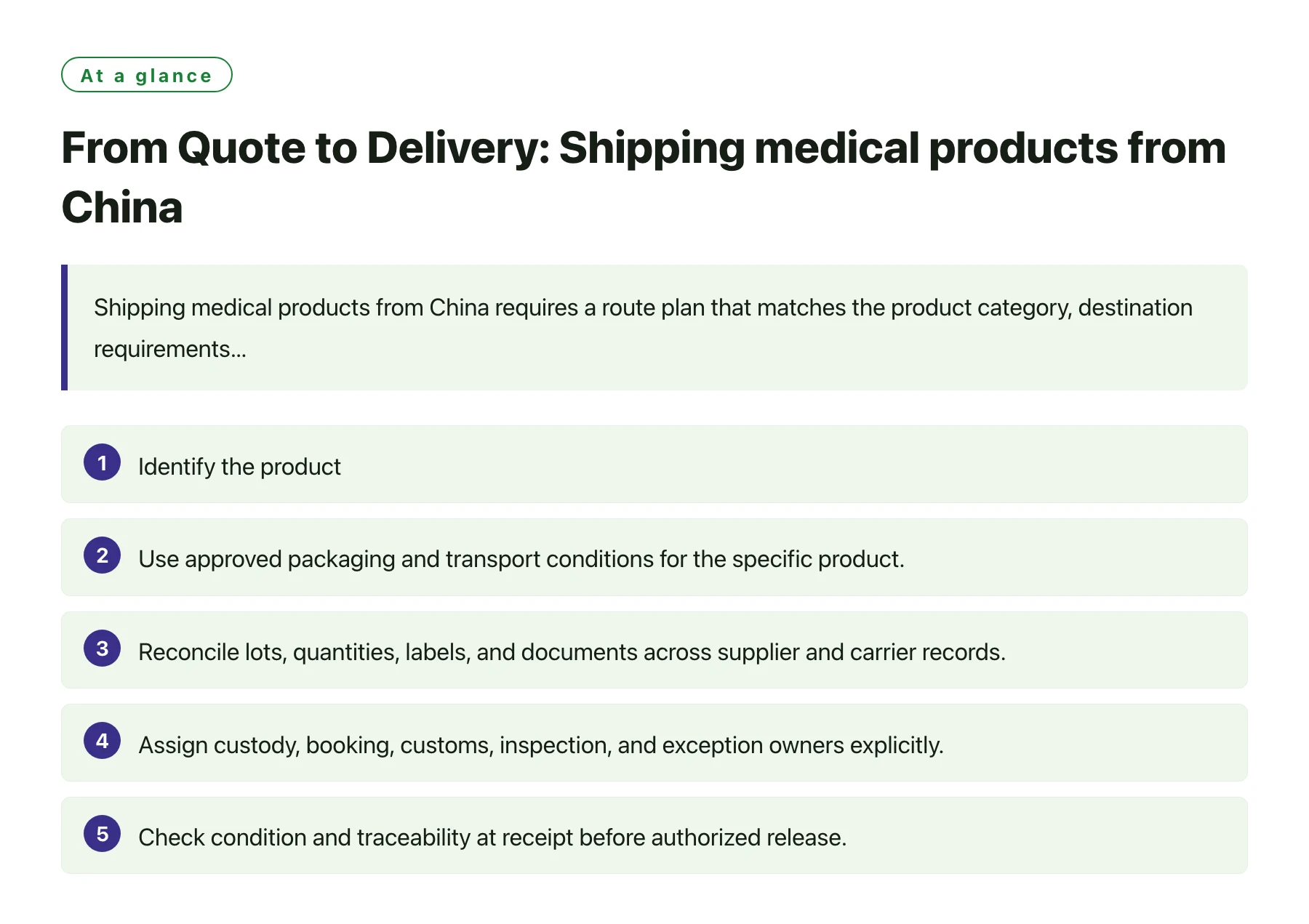
Shipping medical products from China requires a route plan that matches the product category, destination requirements, packaging, traceability, and receiving conditions. Confirm who supplies each document, who controls the import decision, how lots are identified, and what happens if packaging or shipment conditions fail. A shipment is ready only when the assigned owners have reviewed the evidence required for the specific product and market.
Key takeaways
- Identify the product, intended use, destination market, manufacturer, and importer before booking.
- Use approved packaging and transport conditions for the specific product.
- Reconcile lots, quantities, labels, and documents across supplier and carrier records.
- Assign custody, booking, customs, inspection, and exception owners explicitly.
- Check condition and traceability at receipt before authorized release.
The logistics process should carry forward the same product and lot identity established during qualification and production. This makes it possible to connect shipment records to import review and receiving decisions.
Classify the shipment before selecting its route
Medical products can include devices, consumables, diagnostics, accessories, and other regulated categories. Confirm the product identity, intended use, destination, legal manufacturer, importer, and market status before booking. The shipping plan should not rely on a broad commercial label if customs or product rules depend on a more specific description.
Ask the responsible regulatory owner or broker which documents, declarations, permits, labels, and entry data apply. Requirements depend on product and market. Keep a document matrix with the issuer, required format, model or lot scope, due date, reviewer, and location where the final record will be stored.
For devices entering the United States, FDA describes entry checks that compare declared manufacturer, importer, product description, and applicable compliance information against its systems; mismatches may prompt further review or detention.[1] Confirm the current requirements for the specific product with the importer and qualified regulatory adviser. Do not assume a sourcing or freight coordinator can make the importer’s compliance determination.
Match packaging to product protection needs
Review the manufacturer’s approved packaging and transport instructions. Determine whether the product needs protection from shock, vibration, moisture, dust, static, light, or temperature exposure. Maintain the distinction between the product’s primary packaging, protective shipping packaging, and the outer transport unit; changing one can affect identification or product condition.
For temperature-sensitive products, use the product owner’s approved limits and a qualified packaging or transport solution. Decide whether monitoring is needed, where sensors are placed, who reviews excursions, and what evidence is retained. Do not assume a standard parcel service or insulated box maintains a validated temperature range without supporting information.
For devices or non-temperature-sensitive supplies, focus on package integrity, seals, labeling, carton strength, and protection of delicate components. Agree palletization, stacking limits, moisture protection, handling marks, and carton dimensions. The packing list should identify the packages and products sufficiently for receiving and traceability.
Coordinate records and product traceability
Before collection, reconcile purchase order, invoice, packing list, lot or serial identifiers, manufacturer details, quantity, units, destination, and shipment instructions. Ask who prepares and who verifies each document. Record the final revisions and avoid leaving preliminary quantities in a document set that may travel with the goods.
Preserve the link from shipment carton to finished product lot and manufacturing records. If devices are serialized or consumables are lot-coded, require carton-level identifiers and an unpacking or receiving process that captures them. For mixed shipments, list which lots and item codes appear in each package or pallet.
Confirm that the consignee, importer, and broker have the same shipment data before filing. FDA notes that entry information is compared with registration, listing, and product data for relevant devices; accurate declarations help the review process. Have the regulatory owner resolve identity or code mismatches before cargo departure when possible.
Plan custody, handling, and transit timing
Choose the transport mode according to product value, urgency, dimensions, shelf life, handling risk, and route. Ask the provider for the proposed carrier, transfer points, planned pickup, transit estimate, delivery appointment, and exception contacts. Avoid promising a final delivery date based only on a generic transit range.
Write down the named handoff points and the party responsible at each one. Confirm who books freight, arranges insurance if selected, handles export procedures, books customs brokerage, pays destination charges, and coordinates final delivery. The contract and delivery term should define these responsibilities; shipment messages should not quietly reassign them.
For a product with expiry or controlled storage, calculate the remaining shelf-life requirement at a clearly stated point, such as dispatch or receipt, if the purchasing program specifies it. Check the expected transit, customs clearance, and warehouse time against that requirement. Record who may hold or reject a shipment that arrives outside the agreed window.
Use inspection and exception controls before dispatch
Where the product risk and contract require it, inspect package identity, quantity, labeling, condition, seals, and transport preparation before cargo closes. Define whether the check is a full count or sample and whether cartons may be opened. The report should state what was visible and what was not verified.
If there is a mismatch, damaged packaging, unapproved label, missing document, or temperature excursion, contain the affected goods and contact the named decision owner. Record the lot, package, condition, evidence, immediate action, and required disposition. Do not ship against an unresolved high-risk issue solely because a carrier booking is ready.
For a shipment approved with a deviation, document the specific lots, quantity, reason, approver, and limitations. Ensure the commercial and regulatory documents remain accurate. Keep a controlled corrective-action record so the exception does not become an undocumented standard for the next order.
Receive and close the shipment record
At destination, check carrier and seal details, carton count, external condition, product and lot identifiers, and any required monitoring records. Record discrepancies at receipt and preserve photographs, delivery documents, temperature logs, and communications. Move product to the specified storage conditions promptly and document the transfer if the product instructions require it.
Compare receiving results with the pre-shipment report and packing list. Resolve shortages, damage, document gaps, and condition excursions under the buyer’s quality and import process. Keep the lot on hold until the authorized party releases it when required.
For sourcing support with medical products from China, buyers may review medical supply manufacturers in China as part of supplier and shipment coordination. Agree whether the service covers document collection, production follow-up, inspection scheduling, or transport handoff, and retain qualified regulatory and final-release ownership with the importer.
Sources
Frequently asked questions
What should be confirmed before shipping a medical product?
Confirm classification and destination requirements, product and lot identity, approved packaging, documents, shipment roles, transport conditions, and the release owner for the order.
Do medical products always need temperature-controlled shipping?
No. Use the storage and transport conditions specified for the actual product. Temperature monitoring or specialized packaging is appropriate only when the product requirements and risk call for it.
Who is responsible for import compliance?
The importer and its qualified regulatory or customs advisers should determine applicable requirements. A sourcing coordinator can help collect records but should not be assumed to replace that decision owner.
What should be checked at receipt?
Compare cartons, condition, lot identifiers, and required monitoring or import records with the shipment plan. Document discrepancies and follow the authorized hold and release process.